
A Sermon on Matthew 4:12-23
by Rev. Chris Bohnhoff
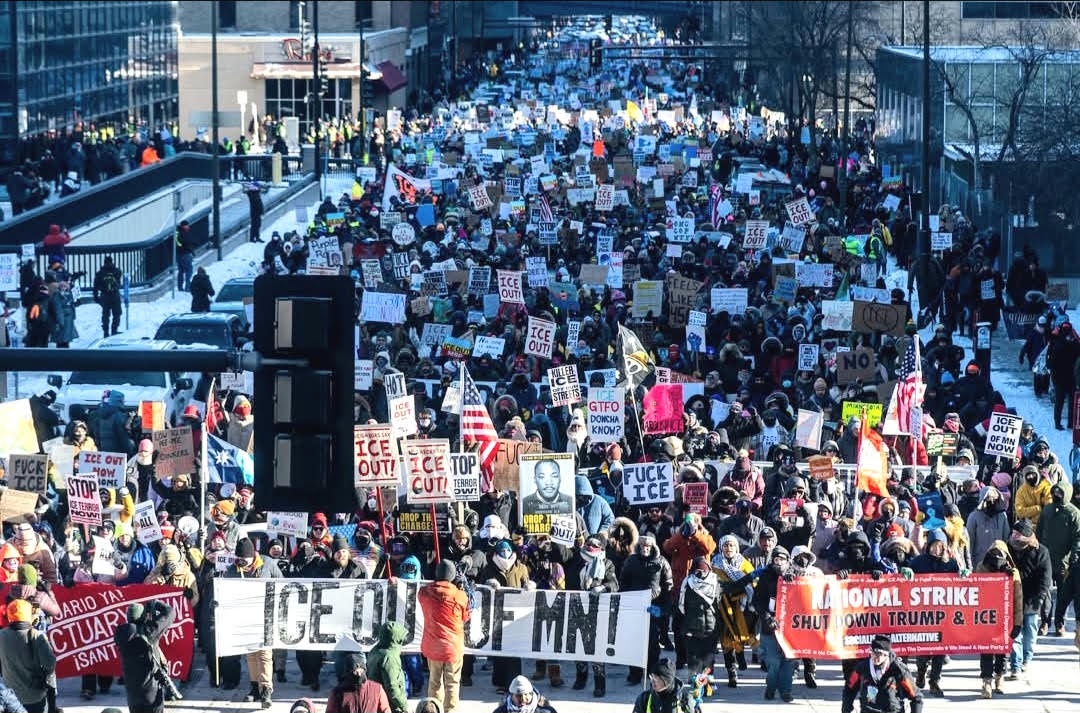
Given the density of time this month in Minnesota, it’s hard to believe that it’s already been nine days since 50,000 of our friends and neighbors marched through downtown Minneapolis. And it’s only been eight days since Alex Pretti was killed some twenty blocks from that gathering.
Anxiety and challenge alter our sense of time’s passing. When upheaval arrives, and we are called to adjust our lives to a new set of circumstances, days often feel like weeks, weeks like years. But in these times, our sacred stories can help us maintain our perspective by revealing the spiral nature of time. We can visit the Bible through the eyes of today and realize that our spiritual ancestors have been where we are; they, just as we are today, made space to respond to injustice, radically altering their daily routines not because they wanted to, but because they needed to.
Will you pray with me? God of mercy, be with us, we pray. Be with us in our jangled nerves, our bad sleep, our brain fog, and our righteous anger. Be with us in the streets as we scrutinize every full-size SUV on the road, and even every act of human kindness for signs of danger. Send your Spirit to remind us in your small but sure way that we cannot go where you are not, and that muscle never gets the last word in your infinite economy of grace. We are your people, whatever the apparent cost. Amen.
I don’t know if I would go so far as to call it a silver lining, but one thing I’ll say about having your city occupied by Border Patrol agents: it puts the story of Jesus in a different, more vivid light. For the record, given a choice, I’d rather not be occupied.
This Epiphany season, we’ve been looking at the first glimmers, the gathering of light from Jesus’ early story, from birth to early ministry. In this week’s reading, Jesus’ first disciples dramatically drop their nets to join that light. Four men left their families and jobs behind, seemingly in the blink of an eye. I think many of us have wondered, How could they just up and leave their lives like that? Because the brief episode gives the impression of spontaneity. But I’ve been thinking about what is left unsaid in the story, and I wonder.
By this early point in the story, Jesus has already been a target of the state. Born in circumstances that were hard to explain, when a small child, he and his family were forced to flee to Egypt because King Herod, to protect his power, ordered all male children in Jesus’ hometown killed. He escaped the broad, cruel net of infanticide that had been cast for him, but an untold number were caught.
Matthew’s gospel doesn’t tell us when Jesus returned from Egypt, or how old he was when John baptized him and later moved to Capernaum on the shores of the Sea of Galilee. But biblical scholars provide some pieces to the puzzle. One big puzzle piece: Ched Myers tells us that “In the year 14 CE, Caesar Augustus died and Tiberius became the ruler of Rome. To curry the new emperor’s favor, Herod Antipas… began building a new capital city called Tiberias on the shores of the Sea of Galilee…. The primary function of this city was to regulate the fishing industry around the Sea of Galilee, putting it firmly under the control of Roman interests. There Antipas built a royal palace, where it is likely he beheaded John the Baptist.”[1]
So, underneath the story of Jesus’ early ministry, Israel’s social system was going from bad to worse. The death of an emperor on the other side of the Mediterranean triggers the dismantling of a local economy. Where the Sea of Galilee used to be a place where fishing families like the ones in our passage could make a living, during Jesus’ lifetime Herod took away that ability by enforcing a new economic system that shipped the fish out of Galilee to Roman cities around the empire and siphoned off the profits for the new emperor instead. Communities like Capernaum were taxed more, with less food for their families.
In this landscape of oppression and shrinking space to simply support oneself, Jesus receives his calling during his baptism. But before proclaiming the very message that his cousin, John the Baptist, proclaimed—“Repent, for the kingdom of heaven has come near”—Jesus hears that John has been arrested. More danger, another forced move, this time to Capernaum, on the other side of the Sea of Galilee from the new Herod stronghold, Tiberias.
Simon Peter and Andrew, James and John didn’t drop their nets out of the blue. Their family businesses had cratered. Society looked down on them as country hicks, as dirty day laborers. All paths to safety, all the levers of power were wielded by the Romans. Life was grim. And then Jesus said, follow me.
People do not, in general, make changes of any magnitude because they want to. The Buddha did not leave his parent’s palace for adventure. Martin Luther King didn’t lead the Montgomery bus strike or the Memphis sanitation workers strike for fame. Simon Peter and Andrew didn’t leave their boat because they wanted a better-smelling job.
And 50,000 Minnesotans didn’t march in the worst cold in seven years to get a tan. No. At a certain point, it hurts more to stand still and endure the injustice than it does to step into the uncertainty and danger of its alternative.
Because the Bible is a collection of writings by authors with differing agendas, it can be easy to dwell on the competing agendas: the questions of Jews vs gentiles, and faith vs works, and divine vs human. But when we intellectualize our reading, we forget that Jesus’ ministry is deeply embedded within a historical moment of occupation, and breeze over the hardships that go unsaid in our sacred stories.
It’s easy to forget, or at least downplay the historical context, until you yourself are occupied, anxiously looking over your shoulder for the enforcers of a regime that values the brute wielding of violent power over mutual thriving and justice; until you’re staring at economic systems bent on extracting rare earth minerals from your most treasured landscapes and running pipelines through sovereign Indigenous lands; until you and your neighbors are the ones labeled ‘domestic terrorists’ for the sole act of witnessing to and naming the senseless brutality coming down on the heads of your neighbors who happen to have brown skin.
This is a moment when we find ourselves in the Bible in embodied, not just intellectual ways.
Over the coming months, as we move through Epiphany, Lent, and Holy Week, our opportunity is to encounter these stories of Jesus through new eyes. As our country does its best to grapple with how its leaders wield authority—whether collaboratively and with restraint, or brutally and above the law—we as individuals and as a congregation have the responsibility to decide how we will show up.
By our presence here, we declare ourselves followers, or at least students of Jesus. Political circumstances have brought us nearer to Jesus and the disciples than we may have ever been. This disquieting reality also contains an electric epiphany: Jesus’ life was spent working nonviolently for occupied people like us.
The upcoming church seasons take us to the heart of Jesus’ teachings. May we take advantage of this opportunity to learn his old teachings in new, embodied ways. May we be clear-eyed about the empire in our midst, and equally clear in our response. May we utilize this community as a place to ask questions, learn, gain spiritual sustenance, express our fears, and mobilize to do the work. And may we learn the lessons of the past so that we can bring wisdom, nonviolence, and compassion to our world. May it be so. Amen.
[1] https://radicaldiscipleship.net/2015/01/22/lets-catch-some-big-fish-jesus-call-to-discipleship-in-a-world-of-injustice/
Leave a Reply