
Image via Head Topics
A Sermon on Matthew 17:1-9
by Rev. Chris Bohnhoff
Will you pray with me? God of infinity, God of endless diversity, we thank you for creation, whose web holds an honored place for each beloved being. Hold us in your light, we pray, and reveal the wisdom held in our sacred stories and our own lives, for you are embedded in them all. Amen.
I didn’t expect my last mountaintop moment. I arrived home from church just before halftime of the Super Bowl two weeks ago, and Johanna had the game on. I wanted to see the halftime show, because it’s always a spectacle—the biggest stage on the biggest day—and because of the controversy. Bad Bunny, the featured artist, performs in Spanish, and some had objected. Loudly. I had never listened to his music.
Bad Bunny, whose given name is Benito Antonio Martínez Ocasio, is one of the world’s biggest pop music stars. His home is Puerto Rico, a territory of the United States since 1898, supported inconsistently by its colonial occupier and without representation in the US Congress.
The halftime show began with a worker on a sugar plantation, constructed on the football field. He smiled at the camera and said words that recall Peter’s “It is good for us to be here”—the worker’s words translate roughly to “How delicious Latino culture is. It is visible today.” Both ground their scenes in gratitude, in the moment.
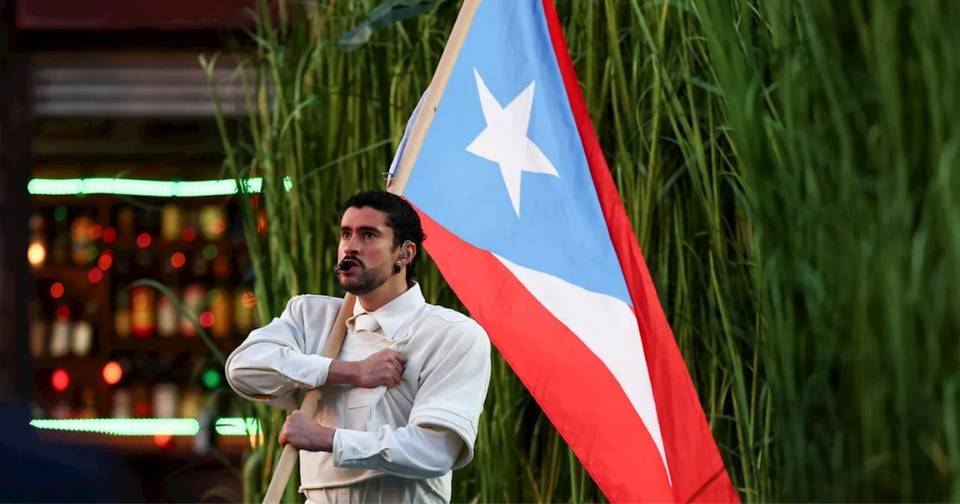
Out of the sugarcane emerges Bad Bunny dressed in white, rapping his hit songs. He wears a jersey with the number 64, a reference to the government’s reported death toll from Hurricane Maria in 2017 when the true toll was well into the thousands. The songs he performs are gritty hip hop in distinctive Puerto Rican style, and as he rapped he walked through scenes that lift Puerto Rico’s culture: he visits street vendors and shop counters, passes a man proposing to his girlfriend and in between boxers, and emerges at a replica of a typical Puerto Rican home. Bad Bunny’s music, full of energy and joy, is the thread pulling these cultural snapshots together, and the party intensifies.
He climbs to the roof of the house, the crowd dancing below, and falls through the roof. A camera captures him inside dusting himself off as a family stares back. He kicks open the door to return to the party and its deeply human mix of bodies and desire, a vision of what embodied Latinx community must feel like.
Violins replace the poppy reggaeton beats and Benito is close to the camera. He tells the audience, “If there is one reason that I’m at Super Bowl 60, it’s because I never stopped believing in myself.”
Cut to an actual wedding with guests young and old, real people not solely beautiful professional dancers, a joyful, faithful, authentic embodiment of Latinx culture. Lady Gaga, a White star, performs her current hit backed by a Puerto Rican big band, beautifully transfiguring it into a Latinx expression. Benito wanders the wedding dancefloor, waking up a sleeping child at the party’s edge, always moving through the joyful wedding crowd. “Dance without fear. Love without fear,” he tells the wedding guests. Then he drops out of the wedding and into the Puerto Rican diaspora in New York City, the joy continuing, smiles everywhere, dancing with abandon.
Cut again to a young boy with his family watching on a small TV Bad Bunny accepting one of the Grammys he won recently. Benito steps into the living room scene, gives the grammy to the boy, and tells him to always believe in himself. Joy. Pride. Authenticity.
Cut to Ricky Martin, another huge Puerto Rican pop star from the recent past, but one who sometimes did what the entertainment industry required of him to “succeed,” singing in English, keeping his sexual identity to himself. He sings another of Bad Bunny’s songs, “Lo Que Le Pasó Hawaii,” What Happened to Hawaii. A song about home, about the dangers of colonialism. A song of independence. He sings, “They want to take away the river. They want to take away the beach. They want Grandmother to leave. Don’t let go of the flag.”
Then back to the sugar fields, where electric poles rise and Bad Bunny grips Puerto Rico’s pre-territorial flag and sings “El Apagó,” The Blackout, another reference to the country’s challenges moving forward from recent tropical storms. But the power outage doesn’t stop the joy; the dancing continues to the beat of accoustic percussion.
Finally, the closing moment, the final statement. With the joy-filled crowd of dancers and wedding guests behind him, Bad Bunny shouts, “God Bless America!” and lists every country in the western hemisphere, starting at the southern tip, through the Caribbean and Central America, ending with the United States and Canada. He flashes a football at the camera emblazoned with the words, “Together, we are America,” while behind him, the jumbotron blared in English, “The only thing more powerful than hate is love.”
Culture. Ancestors. Land. A dreamlike place that is somehow more real than the everyday. An assemblage of love and belovedness in the context of existential danger to whole cultural groups. These are things that the gospel story of Jesus’ transfiguration and Bad Bunny’s halftime show share.
Over the centuries, the traditional reading if this passage is that its central purpose is to establish Jesus’ central location in Israel’s prophetic lineage, tying his mission to the liberation of God’s people from bondage like Moses, and naming him as God’s chosen, like Elijah, God’s beloved for the second time. Bad Bunny has transfigured that reading for me. The mountaintop moment that he created spreads that belovedness, that prophetic lineage to us all.
In this age when the powers that be label some bodies illegal, forcing countless people who are simply trying to survive to hide in their homes unable to work or care for themselves or their families, Bad Bunny reminds us that they, and by extension anyone feeling diminished by fear, are still here. No one who can dance with their people, holding the memories of home and ancestors can be erased or forgotten. He sang this reminder and the party grew, and the smiles appeared on the faces of the young and old, shopkeepers and utility workers, queer and straight. Dance without fear, love without fear.
I’ve watched that performance half a dozen times and it makes me cry every time. Because it says so loudly, in syncopated beats and genuine smiles, what so many in our world are declaring in their own unique ways: who I am, the care I show for my neighbors, the love shown to me by my family and community, you cannot take those away from me. They live in places deeper than your guns and injustice can ever reach. And even during the blackouts, even as you try to steal my land, my joy, given by God and taught by the ancestors, is still here, in my people, which is all of us.
Bad Bunny’s halftime show sits next to our community’s mountaintop moments from this year—next to massive marches and pickleball groups taking it upon themselves to feed twelve families—in transfiguring our perception of what is holy.
Just as Peter couldn’t set up camp and live inside the gospel mountaintop moment, we can’t move into that house in the middle of the Super Bowl’s field. We need to return down the mountain, to our lives, to the season of Lent, to the world’s struggles. But as we do, let us remember the power of ancestors, and the land, and family, and dance. May we dance without fear. May we love without fear. Amen.
Leave a Reply