
A Sermon on Isaiah 42:1-9 and Matthew 3:13-17
by Rev. Chris Bohnhoff
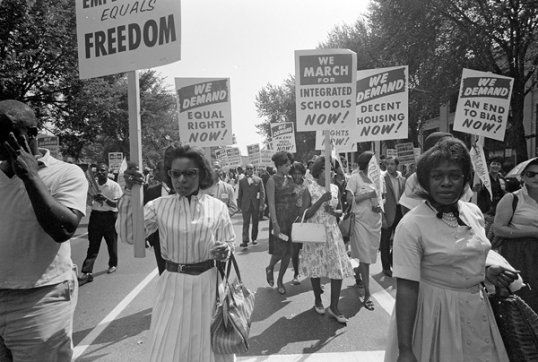
In the mid-1950s, in the middle of the Montgomery, Alabama bus boycotts that catalyzed the Civil Rights movement, from which we remember Rosa Parks refusal to be segregated, the future was uncertain. The legal deck was stacked against people of color, regardless of the circumstances. The KKK was a constant menacing presence, harassing and threatening the boycott’s leader, Martin Luther King, and then the entire African American population of Montgomery daily. King’s home phone rang constantly with these threats, and they began to coalesce into rumors that his friends would pass to him that his life was in danger.
In his autobiography, Stride Toward Freedom, King relates one particularly heavy sleepless night. He writes, “I got out of bed and began to walk the floor. Finally I went to the kitchen and heated a pot of coffee. I was ready to give up. With my cup of coffee sitting untouched before me I tried to think of a way to move out of the picture without appearing a coward. In this state of exhaustion, when my courage had all but gone, I decided to take my problem to God. With my head in my hands, I bowed over the kitchen table and prayed aloud. The words I spoke to God that midnight are still vivid in my memory. ‘I am here taking a stand for what I believe is right. But now I am afraid. The people are looking to me for leadership, and if I stand before them without strength and courage, they too will falter. I am at the end of my powers. I have nothing left. I’ve come to the point where I can’t face it alone.”[1]
Will you pray with me? Holy creator, mysterious center and container for all, we affirm and give thanks for your pervasive presence. In the seemingly ever-increasing pace of human swirl around us, help us to ground ourselves in your delight in love and justice. Beckon to us in your quiet way into joy, into compassion, into heartbreak, into justice. Meet us in our tentative steps and reassure us that past the rush of human action we will find you. Amen.
Christians over the centuries have asked why Jesus asked John to baptize him that day in the Jordan River. Why get baptized, if he was without sin? Isn’t the point of baptism to cleanse a person of the gunk, the mess of human experience? Theologian Mark Allan Powell names a different intention for John’s baptisms. Powell writes, “John is calling Israel to repentance and, though individuals might have personal peccadilloes to confess, the primary focus would be on the sins of the nation. Jesus and others are baptized by John in order to proclaim and participate in a national movement of repentance for Israel and to symbolize a new birth for that nation, a cleansing for the people of God.”[2]
Jesus came not a personal cleansing, but to participate in a communal one.
Both of today’s texts—Matthew in the first century CE and Isaiah in the sixth century BCE—were written in moments when the center of Israel’s collective life had exploded. Their cohesiveness, their communal stability, had disappeared. Isaiah’s community was in exile after a brutal military defeat, humiliated and even questioning whether God had abandoned them—or worse, had also been defeated by the gods of the Babylonians. And Matthew’s community, to whom he wrote his gospel after Jesus’ death, had the ongoing Roman occupation and the destruction of the Temple in Jerusalem to come to terms with.
John the Baptist’s embodied ministry of baptism speaks into that collective brokenness. He appeals not only to Israel’s intellect; he doesn’t seek to win an argument. Instead, he insists that God’s people must get their bodies into the river: that source of life that marked such major moments in their history and everyday existence as a source of fresh water and fish, a thin place between humanity and the natural world and the mystery.
Jesus follows down into the water with the crowd, ready to witness to their nation’s brokenness in sorrow, in anger, in desperation. He submits to the water, to the undeniable flow of life that moves across the landscape regardless of Herod’s evil or Zeccariah’s complicity. He submits to the water, and then he rises. And Matthew tells us that a voice came from the heavens—whether in Jesus’ head or not, we cannot know—God’s voice telling him, “This is my Son, the Beloved, with whom I am well pleased.” (Matt 3:17)
It’s a declaration with roots back to our passage from Isaiah: “Here is my servant, whom I uphold, my chosen, in whom my soul delights,” says God. (Isaiah 42:1-2) Through Isaiah’s prophecy, God describes this Beloved Servant: the bringer of justice to the nations, but not in the expected ways. This servant will not so much as raise their voice. Their strength, their burning wick, all but snuffed out, but through their faith, justice issues forth.
The metaphor of the bruised reed has resonated so hard with me this week. As I perform my little acts of justice, as I move despite the fears, in many moments I feel as sturdy and as substantial as a bruised reed. And so, this passage has shown me real reassurance. Speaking of the servant, God tells us, “They will not grow faint or be crushed until they have established justice in the earth.” (Isaiah 42:4)
This is the work. Not for the singular messiah servant, but through that idea, for all of us. “I have given you as a covenant to the people, a light to the nations, to open the eyes that are blind, to bring out the prisoners from the dungeon, from the prison those who sit in darkness.”(Isaiah 42:6-7)
“See,” God says, “the former things have come to pass, and new things I now declare; before they spring forth, I tell you of them.”
That night in Montgomery, Dr. King prayed for guidance. And God answered. “At that moment,” King writes, “I experienced the presence of the Divine as I had never experienced Him before. It seemed as though I could hear the quiet assurance of an inner voice saying: ‘Stand up for righteousness, stand up for truth; and God will be at your side forever.’ Almost at once my fears began to go. My uncertainty disappeared. I was ready to face anything.”[3]
This is the pattern we remember in Christian baptism. Through ritual, we bring our minds and our bodies to witness to our collective sins. We bring our sadness, our fear, our prayers for the coming of God’s love and justice. We bring the dreams of our whole, righteous selves, and we descend into the water. We feel the flow of life on our heads, and we come to our bodies, our unique specificity, and we receive our name which is at once unique and universal.
We are called God’s beloved, all together. And we affirm the role we fill for each other—as coworkers as we learn, and try, and fail—as well as the role we fill in the creation of God’s commonwealth.
We bring our full, vulnerable honesty to the river, and we receive reassurance. We remember our identity and the love that permeates creation. We remember where the power truly resides and sink into that power’s recognition and claiming of us. And with that reassurance, we receive the strength to keep wobbling, all of us reeds in the breeze standing by God’s grace, somehow participating in the sanctification of the world despite what our limited, dim eyes tell us.
Baptism, that moment of being claimed, doesn’t erase the very real dangers around us. We know that forces of fear did eventually get to Jesus and Martin Luther King. But it can change our perspective by revealing the love and allyship that lies beyond all that threatens us in this life—and the strong thread that is God’s Spirit that joins us all into one family of belovedness. And so, my friends, let us remember gathering at the river. May we bring our full, vulnerable selves, yearning for collective repentance, and may the flow of life meet us. And in that flow, may we feel ourselves named and claimed. And may we gather courage to keep on shaking in the breeze, lifting our calm but persistent voices for justice for God’s people, which is all of us, no exceptions. May it be so. Amen.
[1] Martin Luther King, Jr, Stride Toward Freedom. (Harper & Row: New York, 1986) p. 134.
[2] Mark Allan Powell, Matthew. (Westminster John Knox Press, Louisville, KY: 2023) p. 57-58.
[3] King, p. 134-135.
Leave a Reply