
A Sermon on Matthew 9:35-10:23
by Rev. Chris Bohnhoff
Happy graduation month, church! Especially to our graduates, who can feel proud of their accomplishments over years of showing up and putting in the work. But also, happy graduation month to us all, because nobody does life alone. We rely on each other in small and big ways for support and belonging. We cannot be apart from community, and so when one of us graduates, we can all participate in each other’s accomplishments by taking a moment to make meaning from the experience of completion and moving on.
Will you pray with me? Creator of all things, present and abiding source of love and wisdom, we thank you for all we’ve been given. Today we especially thank you for spaces for learning, and for teachers, and for the whole vast web of schools that teach us about the world and ourselves. We thank you for parents and families who help us feel safe in who we are. We thank you for questions: how does this work? Why did that happen? Who will I become? As we move from one place to another, make us aware of you alongside us, and show us paths to not just live as individuals, but to thrive in community. Amen.
At a certain point in life, you finish graduating from schools. I did something weird, though: I graduated from college, thought for a long time I was done graduating, then, just two years ago and 31 years after graduating from college, I graduated from seminary. That graduation feeling is still fresh for me.
I remember looking forward to being done with seminary all through my last year. I remember the happy celebration when I finished my last assignment.
I also remember the pit in my stomach the day after graduation, when I thought about all the stuff I didn’t know about what would come next. Graduation can be complicated, right?
In today’s story, it was graduation day for the twelve disciples. Jesus had taught them how to make people feel better and be better neighbors to each other, and now he’s sending them into the world with this commencement speech.
His message: you don’t have to save the entire world alone. Just use what you’ve learned to take care of people wherever you are. Also, stay alive so that you can keep taking care of people. That’s your job.
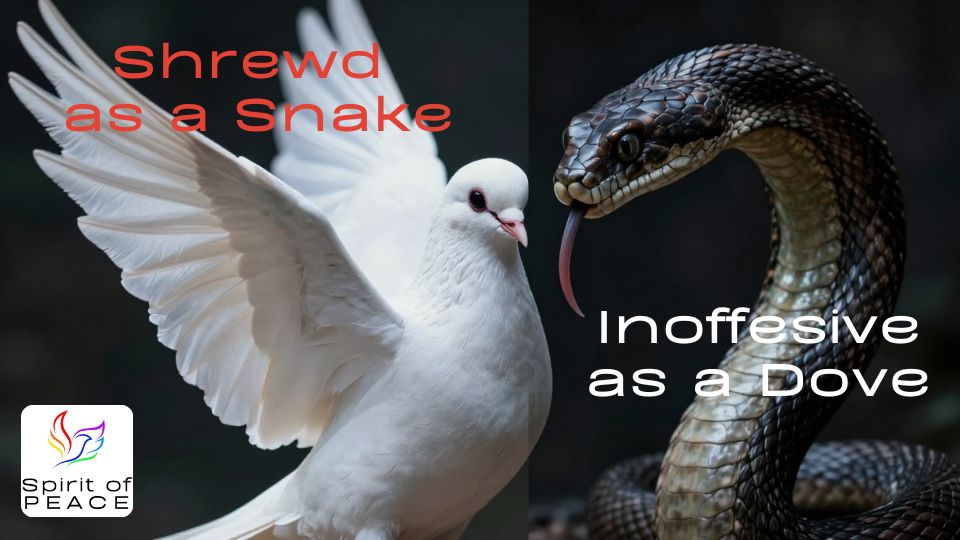
At the center of his lesson is this tricky sentence: “Be as shrewd as a snake, inoffensive as a dove.” What is Jesus talking about?
We’re in church, so the dove part is less tricky. The dove stands for peace: for bringing love and harmony with you wherever you go. To be inoffensive as a dove is to do the things Jesus taught: to go to the people who need help, especially the ones who the rest of the world says don’t deserve help. And when you help, don’t expect to be rewarded or live in a fancy house; just love and the world will give you enough.
But even the dove part gets tricky. As Jesus says, and we know from our own experience, there are plenty of people out there who won’t be happy when you try to help the people who they think don’t deserve help. Some people see a dove and they’re offended.
Here’s where the snake comes in. Snakes here and in Israel live on the ground, so they know how much of creation will step on them if they’re not careful – not shrewd. Because snakes know the habits of other creatures, they can keep themselves safe. They don’t hold it against other creatures; they just find places to be where they won’t get stepped on. They coexist.
When Jesus says to be shrewd like a snake, I think what he’s getting at is that we should do what we do, being nice to people who need a nice person in their lives, but if people get mad at you for doing what you do, it’s OK to leave before you get stepped on. Also, just like snakes can’t get mad at tall animals like us for walking upright and sometimes accidentally stepping on living beings on the ground, maybe it’s not helpful to get too mad when people get mad at you for being nice. “If they don’t welcome you, quietly withdraw,” Jesus teaches. “Don’t make a scene. Shrug your shoulders and be on your way.”
What I hear in this lesson is that it’s our job to love, but we’ve also got to leave space for others to live their lives and be themselves. We can’t expect everyone to see the world in the same way. It’s like in Bluey, where not all the dogs play the same: Bluey and Bingo, blue heelers, can’t play the same way as Snickers the sausage dog or Pom Pom the small but hearty Pomeranian. Coexisting and playing together is how we survive when we go out into the world.
But that’s different than standing by when others are mean. Like when Bluey and Bingo’s younger cousin, Muffin, insisted that none of the rules applied to her because her dad told her that she was the most special kid in the world. Sometimes acting in love means standing up to bullies, not shrugging your shoulders and going away.
You know what’s crazy? Nobody ever totally, once and for all, balances the dove and snake sides of how to be in the world, even after graduating from your very last school. Every situation is different and asks something new of us.
Which is why we need each other. The disciples went out on their own to have their own adventures and learn and struggle, but then they came back together with their teacher and chosen family and talked about the lives they changed for the better – and the times they screwed up when their attempts at care backfired.
So go off on new adventures to learn the ways that only you can care for the world. And when people are mean to you, or don’t understand you, or you have times when you don’t know what to do, remember that you’re not doing anything wrong; you’re having a human experience. And remember what Jesus told his graduates: “Don’t quit. Don’t cave in. It is all well worth it in the end.” And remember that when it’s time for a break from your adventures, we – and lots of churches out there – are ready to welcome and love you, and give you the care that will feed you for the next leg of the adventure. Thanks be to God. Amen.
Leave a Reply